


產品櫥窗
-
Coenzyme A sodium salt hydrate, CoA Na2
|
產品型號:101-55672-92-9 商品規格: |
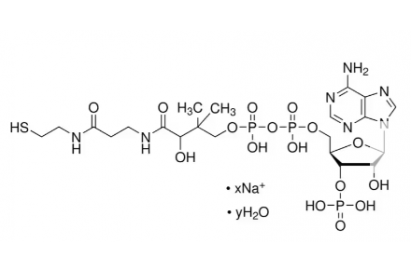 |
Coenzyme A sodium salt hydrate, CoA Na2
Formular: C21H36N7O16P3S · xNa+ · yH2O
MW: 767.53 (anhydrous free acid basis)
Description
Coenzyme A sodium salt hydrate is an essential metabolic cofactor found in all living organisms. It plays a critical role in the synthesis and oxidation of fatty acids, as well as the oxidation of pyruvate in the citric acid cycle (Krebs cycle).
Biological Functions
Acyl Group Carrier: Its primary function is to act as a carrier of acyl groups (such as acetyl or fatty acyl groups). When bound to an acetyl group, it becomes Acetyl-CoA, a central molecule in metabolism.Metabolic Pathways:Energy Production: Critical for the entry of carbon units into the citric acid cycle.Fatty Acid Metabolism: Essential for both the breakdown (beta-oxidation) and synthesis of fatty acids.Protein Regulation: Involved in the allosteric regulation of enzymes and post-translational modifications (e.g., Protein CoAlation during oxidative stress).
Applications
Coenzyme A sodium salt hydrate is suitable for use in:
· gylcerolipid biosynthesis in porcine adipose tissue
· an assay to measure the level of Alpha-methylacyl-CoA racemase (AMACR) in human blood samples using a nanoparticle electrochemical biosensor
· chloramphenicol acetyltransferase (CAT) assay
· the synthesis of palmitoyl-CoA, which is required for palmitoylation and activation of proteins for regulated membrane fusion
Solubility: Highly soluble in water (approx. 50 mg/mL), forming a clear, colorless to faintly yellow solution.Stability: The free acid form is relatively unstable. In the laboratory, it is typically handled as a sodium or lithium salt and stored at -20°C to prevent oxidation of the thiol group into inactive disulfides.
MW: 767.53 (anhydrous free acid basis)
Description
Coenzyme A sodium salt hydrate is an essential metabolic cofactor found in all living organisms. It plays a critical role in the synthesis and oxidation of fatty acids, as well as the oxidation of pyruvate in the citric acid cycle (Krebs cycle).
Biological Functions
Acyl Group Carrier: Its primary function is to act as a carrier of acyl groups (such as acetyl or fatty acyl groups). When bound to an acetyl group, it becomes Acetyl-CoA, a central molecule in metabolism.Metabolic Pathways:Energy Production: Critical for the entry of carbon units into the citric acid cycle.Fatty Acid Metabolism: Essential for both the breakdown (beta-oxidation) and synthesis of fatty acids.Protein Regulation: Involved in the allosteric regulation of enzymes and post-translational modifications (e.g., Protein CoAlation during oxidative stress).
Applications
Coenzyme A sodium salt hydrate is suitable for use in:
· gylcerolipid biosynthesis in porcine adipose tissue
· an assay to measure the level of Alpha-methylacyl-CoA racemase (AMACR) in human blood samples using a nanoparticle electrochemical biosensor
· chloramphenicol acetyltransferase (CAT) assay
· the synthesis of palmitoyl-CoA, which is required for palmitoylation and activation of proteins for regulated membrane fusion
Solubility: Highly soluble in water (approx. 50 mg/mL), forming a clear, colorless to faintly yellow solution.Stability: The free acid form is relatively unstable. In the laboratory, it is typically handled as a sodium or lithium salt and stored at -20°C to prevent oxidation of the thiol group into inactive disulfides.
Store at -20°C