

產品櫥窗
-
Quercetin
|
產品型號:101-117-39-5 商品規格: |
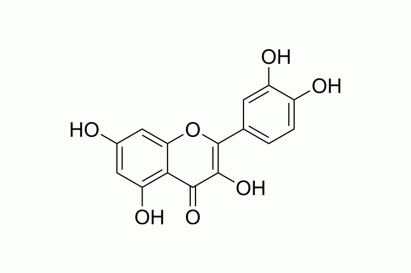 |
2-(3,4-Dihydroxyphenyl)-3,5,7-trihydroxy-4H-1-benzopyran-4-one, 3,3′,4′,5,6-Pentahydroxyflavone
Formular: C15H10O7
MW: 302.24
Description
Quercetin is a polyphenolic flavonoid, found in food including onions, asparagus, buckwheat, radish leaves, green tea, cranberry, broccoli, apple, blueberry, and coriander. Quercetin shows strong intramolecular H-binding, which contributes to the bioavailability and transport of the compound. This explains the biological multi-functional nature of the compound and allows for the formation of strong complexes, frequently with metals. Quercetin inhibits cellular proliferation and minimizes DNA damage. Among its many cardiovascular protection properties, quercetin has antioxidant and antiplatelet properties as well as antiplatelet and anti-muscle cell proliferation and migration. It also enhances cardiac cell mitochondrial function and inhibits NF-κB. Numerous animal studies involving dietary quercetin supplementation have shown a protective effect against cardiac problems.
Applications
Quercetin has been used as an antioxidant which reversed the immunosuppressive effects of high glucose and hyperglycemic sera in type 2 diabetic patients.
It has been used as a detoxifying phytochemical in Apis mellifera.
It has been used as a positive control in DPPH (2,2- diphenyl-1-picryhydrazyl) radical scavenging assay. It has also been used for the preparation of calibration curve to determine total flavonoid content.
MW: 302.24
Description
Quercetin is a polyphenolic flavonoid, found in food including onions, asparagus, buckwheat, radish leaves, green tea, cranberry, broccoli, apple, blueberry, and coriander. Quercetin shows strong intramolecular H-binding, which contributes to the bioavailability and transport of the compound. This explains the biological multi-functional nature of the compound and allows for the formation of strong complexes, frequently with metals. Quercetin inhibits cellular proliferation and minimizes DNA damage. Among its many cardiovascular protection properties, quercetin has antioxidant and antiplatelet properties as well as antiplatelet and anti-muscle cell proliferation and migration. It also enhances cardiac cell mitochondrial function and inhibits NF-κB. Numerous animal studies involving dietary quercetin supplementation have shown a protective effect against cardiac problems.
Applications
Quercetin has been used as an antioxidant which reversed the immunosuppressive effects of high glucose and hyperglycemic sera in type 2 diabetic patients.
It has been used as a detoxifying phytochemical in Apis mellifera.
It has been used as a positive control in DPPH (2,2- diphenyl-1-picryhydrazyl) radical scavenging assay. It has also been used for the preparation of calibration curve to determine total flavonoid content.
Store at Room Temp.